
原创 Welcome to 中国科学院大学
Call for application:
httpsOfficial website of UCAS International Summer School: httpsApplication Link:
httpsUniversity of Chinese Academy of Sciences (UCAS) is a research-oriented university with a high degree of fusion with the affiliated scientific research institutions of Chinese Academy of Sciences (CAS) and focuses on postgraduate education. UCAS welcomes talents from all over the world. UCAS has nearly 2,000 international students from 98 countries, including Denmark, France, Germany, Italy, the United States, Australia, Japan, and more.
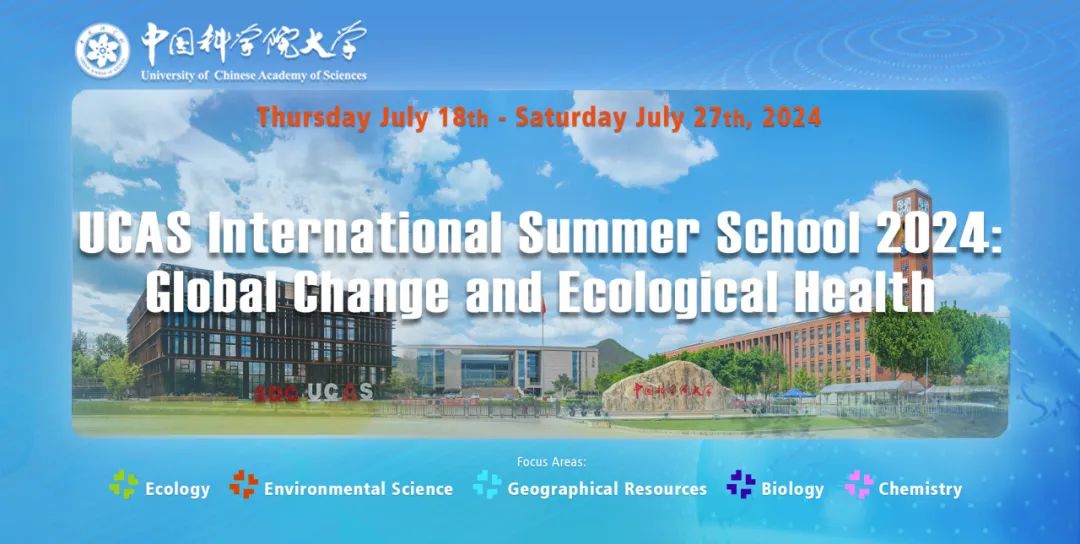
Climate change is one of the world's most critical challenges today, with a far-reaching impact on the planet's ecological balance and human society. To promote exchanges between Chinese and international young scholars to jointly address the effects of global change on ecosystems and actively protect our living environments, UCAS is hosting an International Summer School in Beijing.
I. Time
Thursday July, 18th
—
Saturday July, 27th, 2024
The International Summer School will be organized by Sino-Danish College, and the Sino-Danish Center for Education and Research, UCAS. Participating units include the College of Resources and Environment, UCAS; Research Center for Eco-Environmental Sciences, CAS; Institute of Geographic Sciences and Natural Resources Research, CAS; Institute of Atmospheric Physics, CAS; Institute of Tibetan Plateau Research, CAS and Nanjing Institute of Geography and Limnology, CAS.
II. Highlights
Face-to-face communication with world-renowned scientists
Keynote speeches by academicians of Chinese Academy of Sciences
Field trip to Huairou Science City, and participate in scientific research activities
Recommendation letters for exceptional participants to apply for UCAS scholarships
Experience Chinese culture in Beijing
III. Academic Reports
01
Cryosphere Change
and Global Change
QIN Dahe, Academician of Chinese Academy of Sciences and Professor of the College of Resources and Environment, University of Chinese Academy of Sciences
02
Ecosystem Health and
Sustainable Development
FU Bojie, Academician of Chinese Academy of Sciences and Professor of the Research Center for Ecological Environment, Chinese Academy of Sciences
03
Ecosystem microbiome
science: Exemplified by
antimicrobial resistance
ZHU Yongguan, Academician of Chinese Academy of Sciences and Professor of the Research Center for Eco-Environment, Chinese Academy of Sciences
04
The uplift of the Tibetan Plateau,
the coupled evolution of Asian
Monsoon-inland drought and their
impacts on global climate change
FANG Xiaomin, Academician of Chinese Academy of Sciences and Professor of the Institute of Tibetan Plateau Research, Chinese Academy of Sciences
05
Grassland changes, drivers
and ecological consequences
over 40 years on Qinghai
Tibetan Plateau
WANG Yanfen, Professor, College of Resources and Environment, University of Chinese Academy of Sciences
06
Microbes and Climate Change
WU Qinglong, Professor of the Nanjing Institute of Geography and Limnology, Chinese Academy of Sciences
07
A Study of Water Cycle
in basin using the Integrated
Observation Method
SONG Xianfang, Professor of the Institute of Geographic Sciences and Natural Resources Research, Chinese Academy of Sciences
08
Our future world at global
warming levels of Paris
Agreement
ZHOU Tianjun, Professor of the Institute of Atmospheric Physics, Chinese Academy of Sciences
09
An Introduction to Ecological
Study Based on the Chinese
Ecosystem Research Network
LI Shenggong, Professor of the Institute of Geographic Sciences and Natural Resources Research, Chinese Academy of Sciences
IV. Learning Outcomes
Knowledge
Understand the definition of global change
Understand the characteristics and laws of global change
Master the background, research content and significance of global change science
Understand the process and mechanism of global change affecting ecosystem health
Understand how human activity affects global change
Show overview of the impact of global change on the global ecological environment
Understand how ecosystems adapt to global change
The main environmental problems facing humankind in the global change
Understand global change observation techniques and methods
Skills
Skills in presenting and explaining the relationship between global change and ecosystem health
Skills in applying theoretical concepts to anticipate the impact of global change on human society
Competences
Analyze and discuss the effects of global change on the health of terrestrial ecosystems
Analyze and discuss the impacts of human activities on the health of ecosystems and human
Independent work in groups and writing report
V. Application Requirements
1. The applicant must be non-Chinese citizen, be friendly to China, and be willing to abide by Chinese laws and regulations.
2. The applicant should be in good physical and mental health, without any illness, which is unsuitable for entry into China.
3. The applicant should be an excellent foreign undergraduate student in his/her senior year or above, studying in well-known universities globally, generally under 35. Danish students from SDC Danish partner universities will receive priority.
4. The applicant should have a relevant background in environmental science, ecology, geography, resources, biology, chemistry, and other related majors. Interdisciplinary majors are also welcome to apply.
5. Fluent in English.
6. Applicants with particular scientific research experience and a willingness to apply for master's or doctoral degrees at UCAS will receive priority consideration.
VI. Application Deadlines and Procedure
01
Application Period
April 1st — May 31st , 2024.
02
Application Materials
(1) A scanned copy of the passport's personal information page (valid for at least six months).
(2) Electronic copy of a recent two-inch half-length bareheaded and full-face passport photo.
(3) Certificate of bachelor's or master's degree (Current students provide study certificate).
(4) Transcript of bachelor's or master's degree (Current students provide the latest transcript).
(5) Proof of English proficiency (Not required for native English speakers or students from SDC Danish partner universities).
(6) Recommendation letter from an associate professor or higher (not mandatory).
03
Online Application
Please log in the Online Application System (https) and follow its instructions to finish all the required application procedures. Submit your application in the system as requested within the application period.
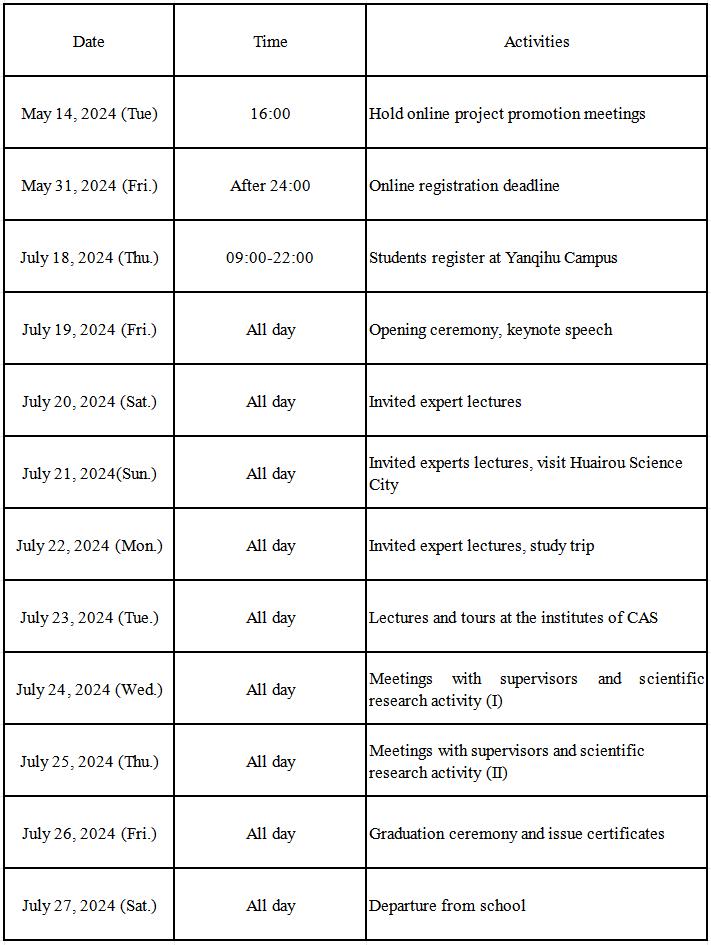
VII. Agenda
VIII. Fees and Scholarship
This summer school is supported by CAS-ANSO Scholarship Non-Degree Program which covers one-off return travel subsidy, tuition waiver, medical insurance, local accommodation and meals.
IX. Contact Information
BAI Qiwei
International Students Office, UCAS
TEL/Mobile: +86-10-62522162
Email: baiqiwei@ucas.edu.cn
WANG Xin
Sino-Danish College, UCAS
TEL/Mobile: +86-13269196612
Email: xinwang@ucas.edu.cn
UCAS
About UCAS
UCAS, formerly named Graduate School of CAS, was the first graduate school in China. In 2014, UCAS started enrolling undergraduate students, and since then an intact higher educational system has been established. Being the largest graduate education institution in China, UCAS has over 60,000 ongoing students, and more than half of them are doctoral students. With strong support from CAS institutes all over China, UCAS espouses the philosophy of “The Fusion of Scientific Research and Teaching” as its basic system of education. The disciplines represented at UCAS include all fields of science and 90% of engineering. UCAS ranked 2nd among world leading university and 1st in China in the institution research output table released recently by Nature Index. According to the Global University Ranking by Essential Science Indicator (ESI) in January 2024, UCAS ranked No. 1 in China and No. 24 worldwide. As a member of the Association of Pacific Rim Universities (APRU), UCAS has established close ties with over 100 world-renowned universities. Based on CAS overseas institutions, UCAS is building overseas joint centers for education and research to promote capacity building on B&R. UCAS is responsible for the enrollment and management of the master’s and doctoral candidates of the ANSO Scholarship Program, Chinese Government Scholarship and UCAS Scholarship for International Students. Read more about UCAS: https
Sino-Danish Center/College
About Sino-Danish Center/College
Sino-Danish Center for Education and Research is a scientific and educational cooperation platform established by UCAS and 8 Danish universities including the University of Copenhagen, Aarhus University, the University of Southern Denmark, Aalborg University, Roskilde University, Technical University of Denmark, Copenhagen Business School and IT University of Copenhagen. The overall objective is to promote and strengthen the collaboration between Chinese and Danish learning environments and increase mobility of students and researchers between China and Denmark.
SDC takes advantage of research and education resources from hundreds of institutes of Chinese Academy of Sciences (CAS) and University of Chinese Academy of Sciences (UCAS) together with all eight Danish universities. SDC creates a unique teaching mode, inviting top talents from CAS and all Danish universities to teach both Chinese and Danish students in one classroom in English.
Sino-Danish College, founded in September 2012, is a Chinese-foreign cooperative school of University of Chinese Academy of Sciences approved by China’s Ministry of Education. The College serves the function of education of the Sino-Danish Center for Education and Research. SDC’s activities include Danish-Chinese research collaboration within five selected research areas and seven Master’s programmes with an annual intake of over 150 Master’s students and training of 50 PhD students.
SDC offers seven Master’s degree programs in English including Water and Environment, Neuroscience and Neuroimaging, Public Management and Social Development, Innovation Management, Life Science Engineering and Informatics, Nanoscience and Technology, International Food Quality and Health. The Doctor’s degree programs currently include five research areas: Environmental Sciences, Life Sciences, Nanoscience, Social Science, and Food and Health. Upon completion of the program, the students will obtain the double degree certificates issued by UCAS and their Danish partner university.
The House of Danish Industry Foundation (SDC building) was donated by the Danish Industry Foundation, and is a visionary, architectural showpiece of Danish design with education, scientific research and accommodation as functions. The building has enabled SDC to compile teaching and research activities under one roof. Read more about SDC:https

原标题:《UCAS Calls for Application!》